What the program is
The Bluff Trail Stewardship Program (BTSP) is a collaborative initiative between the Woodens River Watershed Environmental Organization and the St. Margaret's Bay Stewardship Association. The two organizations secured funding for the launch and started the program in January 2017.
A stewardship program is a set of plans, guidelines and strategies for managing a resource. Some focus on tangible resources such as forest products or animal populations for commercial extraction. Others focus on less tangible assets — public spaces such as wilderness trails — for conservation. The BTSP is the second kind: it seeks the careful and responsible management of The Bluff Wilderness Hiking Trail and the wilderness immediately around it.
That happens through plans, guidelines and strategies; the recruitment and training of volunteer trail stewards; as constant a presence of trained stewards on the trail as possible; and a coordinated effort to engage, inform and support trail users. The ultimate goals are to decrease harmful human impacts, improve Leave No Trace practice among trail users, enhance the sustainability of the trail, and ensure the best possible stewardship of this part of the Five Bridge Lakes Wilderness Area.
Why the trail needs it
The Bluff Trail is a network of roughly 30 km of wilderness trail crossing the Five Bridge Lakes Wilderness Area on the Chebucto Peninsula. It is a remarkable resource: a genuine wilderness experience minutes outside downtown Halifax. Every year many thousands of hikers, photographers, bird watchers, naturalists and recreation groups from Nova Scotia and beyond visit it.
Over the past several years the trail has seen a significant increase in users, and that increase has been accompanied by increased evidence of harmful human impacts on the trail and the ecological systems around it. There have also been violations of the laws that apply inside the wilderness area, resulting in serious harm to the systems the designation was meant to protect.
Because of the length of the trail, the terrain, and the volume of users, the program needs a paid coordinator: the work is too vast to rest solely on volunteers.
Ecological and community stewardship
Ecological stewardship
Human presence and activity create negative impacts on the surrounding ecology. The program's primary intent is to measure, monitor and catalogue those impacts and then select the best techniques for reducing or, where possible, eliminating them. That work includes determining the key habitats for endangered, uncommon or sensitive species of flora and fauna and ensuring tailored treatments are enacted to support their long-term viability — which may mean seasonal restrictions on access, or extra monitoring and outreach.
Community stewardship
The trail's community extends far beyond Halifax Regional Municipality, let alone Nova Scotia. With that level of use comes a responsibility to keep the relationships between stakeholder groups — Mi'kmaq, trail users, nearby residents, environmental and community NGOs — and government departments stable. Not all parties define responsible use the same way. The community side of the program acts as the conduit between government and stakeholder interests while keeping ecological stewardship in view. Its largest component is education and outreach.
Program goals
- Reduce harmful human impacts on the ecological systems and the individual living organisms that call the Five Bridge Lakes Wilderness Area and The Bluff Trail home
- Reduce illegal activity through education and by liaising with Nova Scotia Environment conservation officers
- Educate trail users about harmful human impacts, and about the laws that apply inside a protected wilderness area
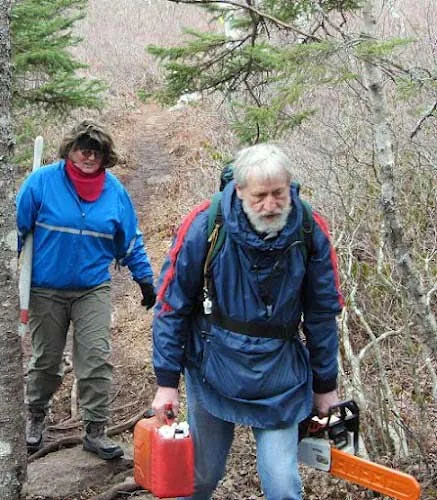
- Recruit, train and support volunteer Bluff Trail Stewards, and hold regular volunteer stewardship work days
- Increase monitoring of on-trail ecological systems, trail infrastructure, community use and user safety
- Monitor and promote proper use of the designated Leave No Trace educational sites
- Increase remediation of damaged sites
- Establish protocols for protecting endangered species, species of interest, and sensitive habitats
- Create a formal compendium of the flora and fauna present on the trail and in the surrounding area
- Expand collaboration with other organizations — post-secondary internships, non-profits, outdoor recreation groups
- Maintain one consistent contact person acting as community and government liaison
- Secure sustainable funding so the program can continue
What gets counted
The stewardship coordinator reports directly to WRWEO and SMBSA, with summary reports to the Five Bridges Wilderness Heritage Trust and Nova Scotia Environment's Protected Areas Branch. Weekly reports record staff and volunteer hours contributed, the number of trail users engaged and educated, occurrences that violate laws or stewardship principles, which trail sections were monitored and when, infrastructure issues identified or addressed, observed fauna and signs, and the total number of dogs seen on and off leash.
Some of this is easily quantified: time on the trail, users engaged, damaged sites requiring remediation, hours spent remediating them. The first year established a baseline. The harder question — whether engaging and educating users actually changes behaviour — needs years of records before it can be answered meaningfully. That is why the year-in-review reports matter, and why they are all published.
Year in review reports
- 2024 BTSP Year in Review
- 2023 BTSP Year in Review
- 2022 BTSP Year in Review
- 2021 BTSP Year in Review
- 2020 BTSP Year in Review
- 2019 BTSP Year in Review
- 2018 BTSP Year in Review
- 2017 BTSP summary
Volunteers can also log their time through Strava, in the BTSP Stewards and Volunteers club.
On trail maintenance
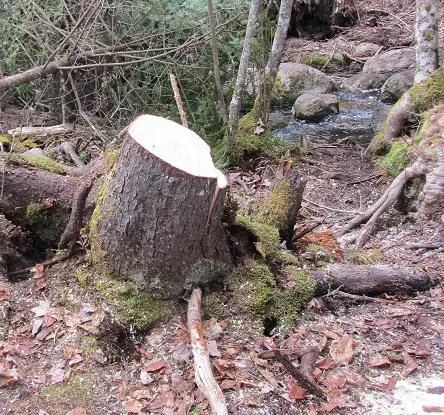
Brush cutting and deadfall removal are standard trail maintenance, and have been going on for more than ten years. Each year the work is done on two loops — loops 1 and 2 one year, loops 3 and 4 the next — so each loop is cleared roughly every 24 months.
Trail users occasionally write to ask whether this detracts from the wild character of the place or deprives species of habitat. It is a fair question, and one WRWEO takes seriously. Without regular brush cutting, many stretches of trail would disappear into thick brush, making the route hard to follow. Deadfall removal is strictly limited to the trail surface and does not extend into the surrounding bush. Large trees across the trail are both a physical hazard and a way-finding problem — and when a section is blocked or hard to follow, people move around the barrier, which widens the path, increases erosion, weakens tree roots, causes more premature deadfall, and starts the whole cycle again.
Regular clearing can look harsh in the weeks after it is done. Every maintenance project is inspected by volunteer board members, and every effort is made to follow best practice. More precise species-aware cutting would be the ideal, but work crews face real limits of cost, time, tools, and sometimes the experience of newer workers. The condition of the trail after two decades is the best evidence that the approach is sound.
Adapted from a letter written to a trail user by Kimberly Berry, then Co-Chair of WRWEO, 6 September 2015.
The boardwalks
Seven boardwalks carry the trail over wet ground. WRWEO gathered GPS positions for all of them along with the signage, and estimated the locations of boardwalks 2 and 3 on a shared map.
| Boardwalk | Coordinates | Feet | Metres |
|---|---|---|---|
| 1 | 44°39′52.0″N, 63°46′11.5″W | 30 | 9 |
| 2 | 44°39′46.7″N, 63°46′07.9″W | 345 | 105 |
| 3 | 44°39′44.4″N, 63°46′04.2″W | 48 | 15 |
| 4 | 44°39′24.6″N, 63°46′00.3″W | 20 | 6 |
| 5 | 44°39′24.5″N, 63°46′00.2″W | 30 | 9 |
| 6 | 44°39′28.9″N, 63°46′33.6″W | 8 | 2 |
| 7 | 44°39′29.2″N, 63°46′28.1″W | 9 | 3 |
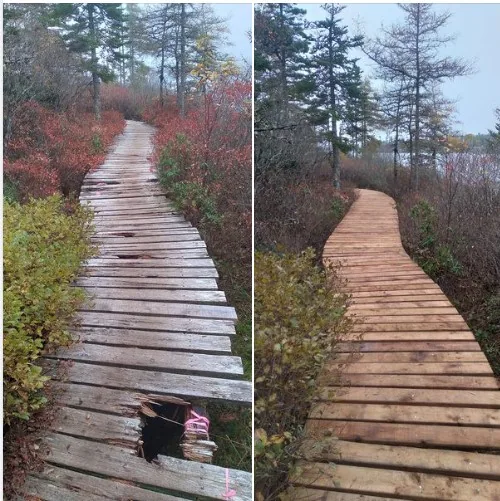
Boardwalk 2, at 105 m, is the long one replaced across 2023 and 2024. Boardwalk 3 was fully replaced in November 2023 for just under $7,000.
What it costs
The total cost of one year of operation in 2017 was $41,567. That covered wages for a stewardship coordinator, an assistant coordinator and four students hired through the Canada Summer Student Work Program, plus some materials and supplies — personal protective equipment, wood for the boardwalks, hardware.
SMBSA and WRWEO have not been able to secure the full amount since 2017, so a modified version of the program runs with reduced coordinator hours and no assistant since 2018. The success and sustainability of the program depend almost entirely on the coordinator's ability to maintain an adequate presence on the trail; reducing those hours reduces that presence, and undermines the program's results.
We are grateful to the Five Bridges Wilderness Heritage Trust, Nova Scotia Environment's Protected Areas and Ecosystems Branch, the RBC Community and Sustainability Grant, and the many individual donors who made the program possible. Continued funding is needed.